
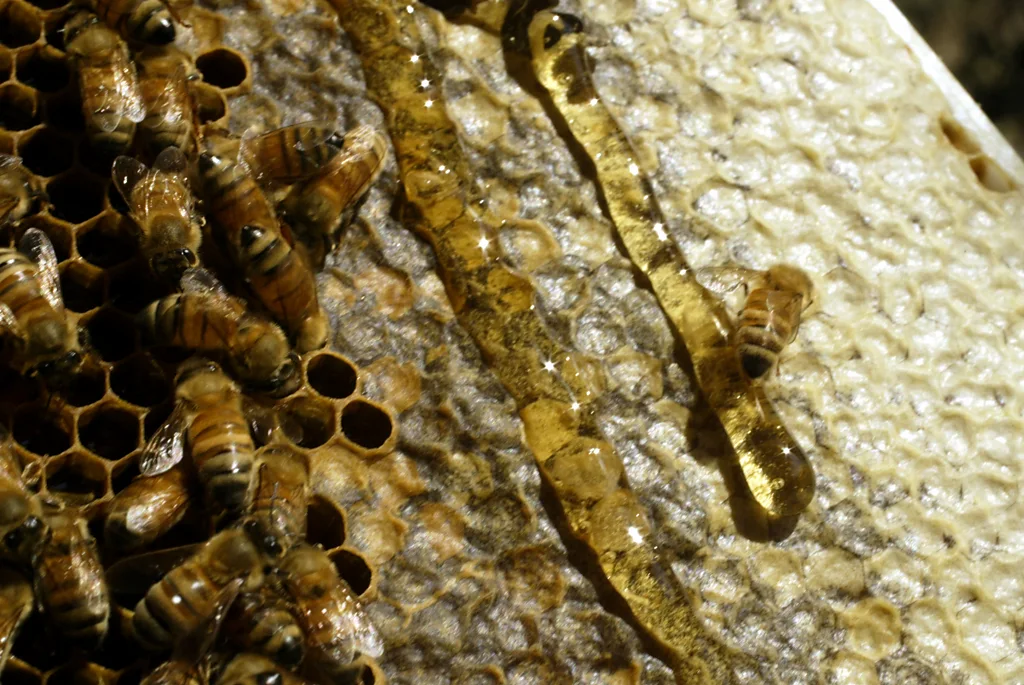
Honey, a natural sweetener beloved by bacteria for its sugar content, possesses a remarkable ability to resist spoilage. While most preserved foods are prone to microbial growth and deterioration, certain items exhibit exceptional longevity, remaining edible for years. Sealed in a jar, honey may undergo crystallization, thickening into a viscous texture, yet it does not deteriorate. This unique resistance to decay is attributed to the chemistry and production process of honey. Spoilage in food occurs when microscopic organisms such as bacteria, fungi, and molds colonize it. Various preservation methods are employed by humans to inhibit the proliferation of these organisms. Microbes typically thrive in moist environments with moderate temperatures, neutral pH levels, and ample oxygen. Dehydration, cooking, pickling, and sealing are common techniques used to thwart microbial growth in food. Despite these efforts, the battle against spoilage organisms is ongoing, as evidenced by the occasional unpleasant surprises found in long-forgotten jars of preserved goods. Honey stands out due to its origin and preparation. Bees transform flower nectar into honey, a sugary liquid that undergoes a series of transformations to become a low-moisture product. The bees’ meticulous process of concentrating nectar, raising acidity levels, and dehydrating the liquid through wing fanning results in honey with minimal water content, making it inhospitable for microbial survival. With a water content of around 15% to 18%, honey achieves a state of “low water activity,” rendering it resistant to spoilage. By sealing honey in jars, oxygen availability is further restricted, creating an additional barrier against microbial growth. This principle of reducing water activity is a common strategy in food preservation techniques, ensuring the longevity of processed foods. Although honey can succumb to spoilage once exposed to air post-opening, its inherent properties make it a resilient food item. Adding water and introducing specific microorganisms can lead to the fermentation process, producing mead, a delightful treat enjoyed under the sun.
This is H2
This is H3
This is bold
This is italic
underline
strikethrough
word_with_subscript
word_with_superscript
bullet 1
bullet 2
bullet 3
Numbered list 1
Numbered list 2
Numbered list 3
This is a citation
Now I test an image embed:

And then an article embed:
And finally a social embed:
Now a link: