
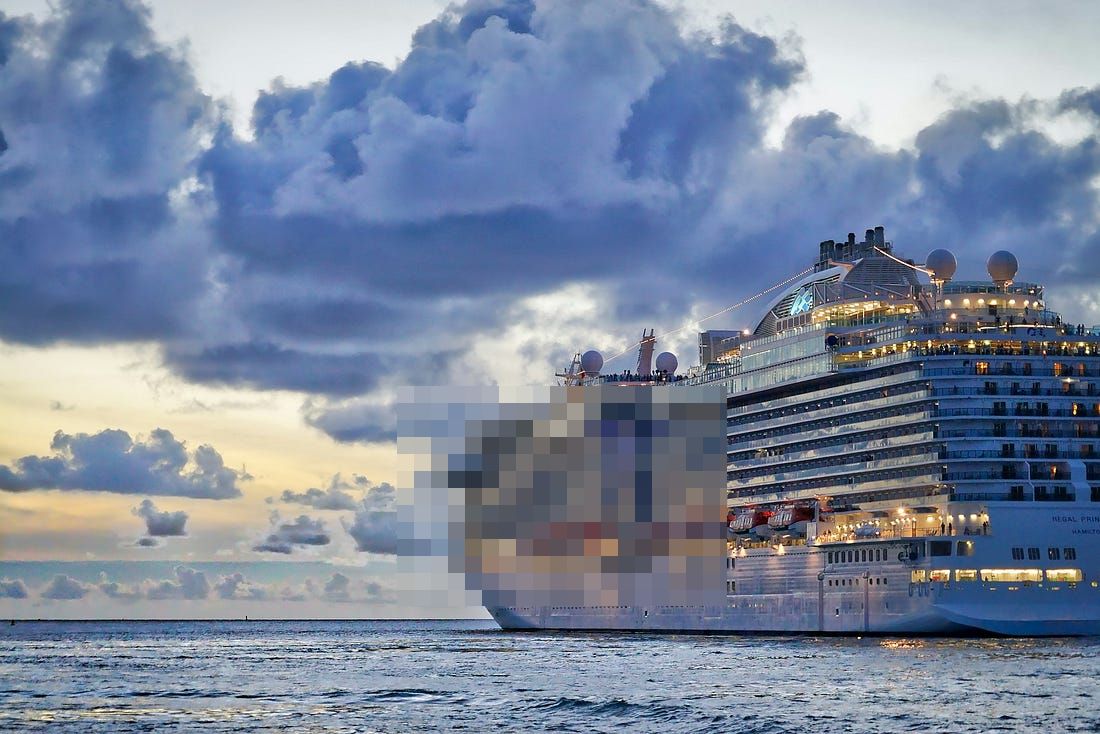
Green tourism has hit the cruise industry. Royal Caribbean has launched its most sustainable ship to date. There’s a roller coaster on board and it has a smaller environmental footprint, as you mentioned. And true to their line, they are betting big on their green innovations. The first cruise ship in America powered by liquid natural gas. Which may explain why 50 percent of Americans believe cruises are environmentally friendly, and the business is booming. What was once a pastime for elitists has now equated to many vacations with more traditional packages. But although many cruise lines claim to be becoming more climate-conscious, the reality may be quite different. How did cruise ships become such a catastrophe for the planet? This is the world’s largest cruise ship, Royal Caribbean’s icon of the seas. Its design is typical of modern cruise ships, big, boxy and wide, as we expect. Something that functions less like a ship and more like a floating resort. But they did not always appear that way. The Princess Victoria Louise, widely considered the first purpose-built cruise ship, is completely different. Like many passenger ships of that time, she has a sleek, streamlined profile designed for speed to carry passengers across the Atlantic as quickly as possible. Over the years, these ships became increasingly luxurious, emphasizing comfort and luxury to attract wealthier passengers. But the advent of cheap transatlantic flights meant that there was no longer a demand for sea travel. As a result, cruise ships focused on voyages to Caribbean ports and warmer climates. And cruise ship design changed to maximize what goes in and on top of the ships rather than speed. Which these days is a lot. The world’s largest cruise ship, the Icon of the Seas, can accommodate nearly 10,000 people. Across its 20 decks, the Icon of the Seas can boast the world’s largest on-board water park with six water slides, a 17-meter-high indoor waterfall, entertainment shows and more than 20 different dining options. But if you are willing to board a slightly smaller ship, the costs can fall well below the average vacation expense. And with falling prices, cruise tourism has become more popular than ever. All this increase in passengers and facilities means that more energy is needed and more waste is produced. To get an idea of the scale of the pollution produced by an average marine-fueled cruise ship, it translates to about 4 times more CO2 per passenger than flying. And it can also emit as much particulate matter as a million cars every day. Europe’s 218 cruise ships in 2022 emitted more than 4 times more sulfur oxides than all the continent’s cars combined. And in addition to emissions, there is oil, sewage, plastic and other harmful chemicals being dumped into the sea. Twenty-five percent of all ocean waste comes from cruise ships, even though they represent only 1 percent of the world’s merchant fleet. And then there is the noise from cruise ships, which displaces fish and predators. And light emissions from ships at night can create problems for the migration of zooplankton, cephalopods and fish. Carnival Cruise Line is admitting to polluting the oceans by dumping oily waste into the sea for years. There are things cruise ships can do to limit their impact, but most companies are not taking such measures. Emissions could be reduced by up to 24 percent if ships decreased their speed. And the use of electrical connections in ports, a cleaner alternative to running highly polluted generators when docked, has led to lower air pollution and greenhouse gas emissions in the cities of Hamburg, Rostock and Kiel. And ships could also use fuel cells and renewable hydrogen or methanol, which emit fewer greenhouse gases. But many have opted instead for natural gas liquids, which reduce carbon dioxide emissions but emit more greenhouse gases overall, as LNG engines leak methane, which retains about 80 times more heat than CO2 in the 20 years after being released into the atmosphere. Royal Caribbean has placed much emphasis on the Icon of the Seas’ green innovations, but while its advanced water treatment technology has been welcomed by environmental groups, its waste-to-energy conversion system has limited benefits.

Its fuel cell batteries have not been installed due to a problem with suppliers, and its shore power capacity can currently be accommodated by only 2 percent of the world’s ports. But port cities in Europe have found a solution. A growing number are restricting cruise ships and some are banning them altogether. Barcelona and Amsterdam are the latest to join. And the bans can have a huge impact. Venice was the third most polluted cruise port in Europe in 2019. But thanks to a ban in 2021 on large cruise ships, the city has reduced sulfur emissions by 80 percent.