
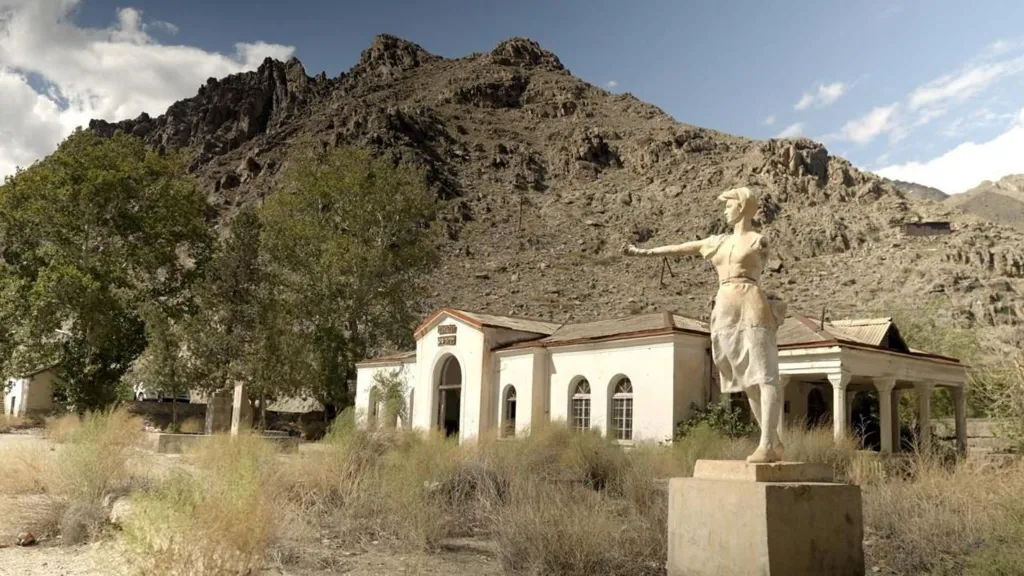
A deserted station, a few decaying carriages, and a short stretch of railway track are the remnants of a Soviet railway in southern Armenia. Surprisingly, this neglected railway has been earmarked to symbolize peace facilitated by the US President on the Trump Route for International Peace and Prosperity, also known as Tripp. Scattered across the area are pieces of a statue’s head dedicated to a communist hero, while a female statue is missing an arm. Local journalist Marut Vanyan refers to the location as the Trump route, or Crossroads of Peace, the Silk Road, and the Zangezur Corridor. However, the current scene does not reflect an American presence. This spot represents one of the conflicts that Trump claims to have resolved through an agreement between Armenia and Azerbaijan. The initiative involves US companies investing in a 99-year project to develop a 43km route along Armenia’s border with Iran, connecting Azerbaijan to its exclave of Nakhchivan. The plan includes the construction of a railway, motorway, and pipelines, with Trump anticipating economic benefits for all three nations involved. Despite the ambitious plans, significant challenges lie ahead. The construction of this transport link from scratch faces political obstacles that overshadow economic considerations. Trump’s involvement could potentially alter the geopolitical dynamics of a region contested by Russia and concerns raised by hardliners in Tehran who threaten to obstruct the project. The Tripp proposal plays a crucial role in resolving the longstanding conflict between Armenia and Azerbaijan over Nagorno-Karabakh, historically inhabited by Armenians but located within Azerbaijan’s borders. In 2023, Azerbaijan regained control of the disputed region, leading to the mass exodus of Armenians from their homes. This displacement echoes similar events in the 1990s when over half a million Azerbaijanis were displaced. Vanyan, among the displaced in 2023, resettled in Armenia’s Syunik province, a new focal point of tension between the neighboring countries. Following Armenia’s rejection of Azerbaijan’s demand for a corridor to Nakhchivan through the Zangezur region, border clashes erupted, raising fears of renewed conflict. In August 2025, Trump intervened unexpectedly, hosting the leaders of Azerbaijan and Armenia at the White House. The agreement reached aimed to satisfy both sides, ensuring unimpeded connectivity for Azerbaijan while respecting Armenia’s sovereignty, with a private US company managing the route. The thin agreement lacks specific details or a timeline for implementing the Tripp project. US mediation was made possible by Russia’s diminished influence in the South Caucasus, where the Kremlin had previously worked on reopening the route now associated with an American president. Despite Russia’s rejected proposal for FSB border troops to secure the future road, they continue to patrol the selected Armenia-Iran border segment for the Trump route. The involvement of US and Iranian companies in Armenia raises questions about their coexistence, particularly amid recent US actions in the Israel-Iran conflict. While Iran’s supreme leader’s adviser issued threats against the project, Iran’s government expressed measured concerns, given its friendly relations with both Caucasus nations. Armenia anticipates new investments in long-abandoned areas, attracting European interest as France sells arms to Yerevan, opens a consulate in Syunik, and deploys an EU monitoring mission in the region. The EU views the future Trump route as part of a larger corridor connecting with Central Asia and China, bypassing Russia. Turkey seeks to capitalize on reduced Russian influence, engaging in talks with Armenia to normalize relations and supporting the Tripp project to establish a direct link from Turkey to Azerbaijan. Armenia remains optimistic amidst competing interests, aiming to foster cooperation among regional powers as a “Crossroads of Peace.” While a formal peace treaty between Azerbaijan and Armenia is pending, Trump’s intervention has brought temporary relief, with no reported incidents along the Armenia-Azerbaijan border since the Washington meeting.
A neglected Soviet railway in southern Armenia is now a symbol of peace, thanks to a US-brokered initiative aiming to resolve the Armenia-Azerbaijan conflict through economic collaboration and infrastructure development.